
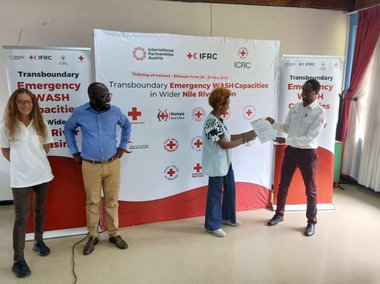
The Transboundary Emergency WASH (eWASH) Project was officially launched during a Kick-off Workshop held in Nairobi, Kenya, from 3–5 March 2026. The event brought together representatives from the twelve participating Red Cross and Red Crescent National Societies across the wider Nile River Basin in East Africa, alongside colleagues from the Austrian Red Cross, IFRC, ICRC, and Partner National Societies. Participants reviewed regional WASH capacities, identified priority transboundary risks—including floods, droughts, cholera outbreaks, and population displacement—and agreed on a roadmap to strengthen cross-border cooperation, surge mechanisms, logistics systems, and emergency WASH preparedness.
A key outcome of the workshop was the establishment of a regional Training of Trainers (ToT) initiative to support sustainable capacity development across the region. The first eWASH ToT was held in Addis Ababa, Ethiopia, from 25–29 May 2026, bringing together 16 WASH professionals from National Societies and Movement partners in Ethiopia, Kenya, Rwanda, Tanzania, South Sudan, and the Democratic Republic of Congo. Through an interactive learning approach, participants enhanced their skills in facilitation, adult learning, training design, communication, and evaluation, creating the foundation for a regional pool of qualified WASH trainers. A second ToT is planned for September 2026 in Rwanda.
The newly trained facilitators are expected to lead national and regional emergency WASH trainings, mentor future responders, and promote harmonized training standards across participating National Societies. Beyond strengthening individual capacities, the ToT has fostered a regional network of trainers that will support knowledge sharing, peer learning, and the localization of emergency WASH expertise.
Building on these achievements, the project will now roll out Basic Emergency WASH trainings and other specialized capacity-development activities across participating countries. The first national-level Basic Emergency WASH training is scheduled for August 2026 in South Sudan, followed by trainings in Kenya and Ethiopia. Additional priorities include strengthening regional surge deployment mechanisms, enhancing emergency stock readiness, expanding knowledge-sharing platforms, and promoting greater participation of women in technical WASH leadership roles. Together, these efforts are laying the foundation for a stronger, more coordinated, and more resilient regional emergency WASH response system.