Humanitarian work in conflict zones increasingly requires highly specialized emergency and crisis management. Globally, chemical, biological, radiological, and nuclear (CBRN) risks are coming more into focus for aid organizations. That is why I was deployed to Ukraine for 6 weeks in February as a CBRN Specialist.
If the lights were to suddenly go out and a warning app started howling on a smartphone, Austria would be in a state of emergency. In Kyiv, due to their frequency, these warnings hardly cause a stir anymore. Even before and since the outbreak of the war, I had frequently been to Ukraine for humanitarian reasons, so I was well-equipped whenever a power outage stopped the heating and the room temperature dropped rapidly.
The surreal yet highly pragmatic everyday life in Kyiv fascinated me in particular: During the frequent air raid alerts, people meet in the safe space (a “protective room”; a precursor to a bunker/shelter) and chat about the weather as if there were no war raging outside. "A coping mechanism for people like us!"
When you're enjoying a coffee in the sun at a café on a beautiful weekend – and suddenly the air raid siren sounds –, many just pause for a moment before continuing the conversation. It is astonishing with what unagitated calmness the population of Kyiv accepts this as part of the new normal.
My work took place in this area of tension between a (life-)threatening background and pragmatic everyday life. The WeC (Weapon Contamination) Unit, the department at the ICRC which primarily deals with the hazards of weapon contamination and unexploded ordnance, hosts the CBRN component that forms a highly specialized niche within the subject matter.
I´m calling it the "nerd amongst the nerds" within the delegation, as there are few direct touch points with these highly specific topics in everyday humanitarian work. The CBRN specialists support with technical expertise, thus my core responsibilities lay in the sound risk analysis of potential hazards – such as from industrial facilities or the effects of war – as well as in strategic consulting in CBRN, reconnaissance, and contingency planning.
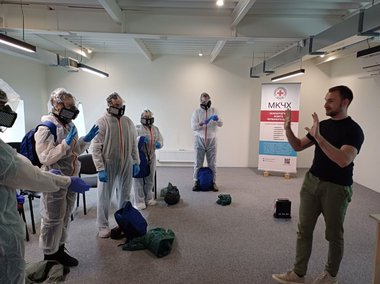
Among other things, I developed Standard Operating Procedures (SOPs) for technical equipment and protective gear, along with respective training plans. Corresponding training sessions for staff complemented my work, at times being held in the shelters due to the tense security situation. My work also included the professional exchange with local authorities on handling complex risk situations.
This first mission with the ICRC, showed me how important it is to translate theoretical risk analyses into precise, applicable, and clearly understandable instructions for those who have to use them.