Strengthening Protection, Gender and Inclusion (PGI) within National Societies requires more than one-off trainings - it requires dedicated individuals who carry the agenda forward within their institutions. Under the ADA-funded Skybird II programme, the establishment of PGI champions is emerging as a key strategy for sustainable and system-wide integration of PGI principles.
In Rwanda, an important milestone was reached with the recent PGI Champions Workshop conducted by the Rwanda Red Cross Society (RRCS). This builds on the Training of Trainers (ToT) held in November 2025, which equipped 16 staff and volunteers from across districts with advanced knowledge on PGI, safeguarding, PSEA, and gender-transformative programming. TheToT aimed to equip participants with a strong foundation, enabling trained participants to cascade PGI knowledge. Over the long- term the initiative seeks to embed PGI principles across programmes, governance structures and community engagement processes. This reflects a core vision of the Skybird II programme and marks an important step in what is ultimately a long-term journey towards meaningful institutional change.
Building on this foundation, the workshop brought together 17 participants (8 women and 9 men), including project and branch coordinators selected based on their roles in programme implementation and institutional processes. From this group, dedicated PGI champions will be identified. Through interactive discussions and practical exercises, participants strengthened their capacity to integrate PGI throughout the programme cycle—from design and beneficiary selection to monitoring and reporting. PGI Champions are expected to advance and mainstream PGI across sectors and programmes within RRCS, and to apply and share the knowledge and skills gained through the programme within their respective organizations.
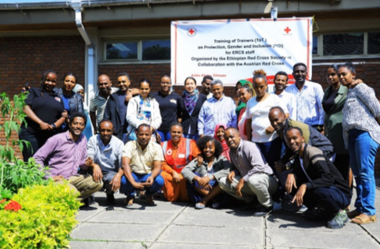
A similar approach is being advanced in Ethiopia. In 2025, the Ethiopian Red Cross Society (ERCS) conducted a two-step capacity-building process, starting with a basic PGI training followed by a four-day ToT for 21 participants. This equipped participants with technical knowledge and facilitation skills to cascade PGI, safeguarding, and PSEA trainings. These individuals are positioned to act as future PGI champions at branch and institutional level, supporting long-term institutionalisation of PGI across ERCS.
Looking ahead, the programme will build on these efforts through the roll-out of PGI-related activities within Skybird II branches, including integration into WASH, health, and livelihood interventions. This next phase will be critical in translating training outcomes into tangible community-level impact, ensuring that the principles of dignity, access, participation, and safety are consistently applied.
Across Rwanda and Ethiopia, the establishment of PGI champions marks a shift from one-off capacity-building to a sustained institutional approach. By investing in individuals who can drive internal change, the programme is laying the groundwork for long-term transformation - where PGI is not an add-on, but a core component of how National Societies design and deliver their work.
Together, these efforts contribute to a shared vision: National Societies that are inclusive, accountable, and responsive - ensuring that no one is left behind.