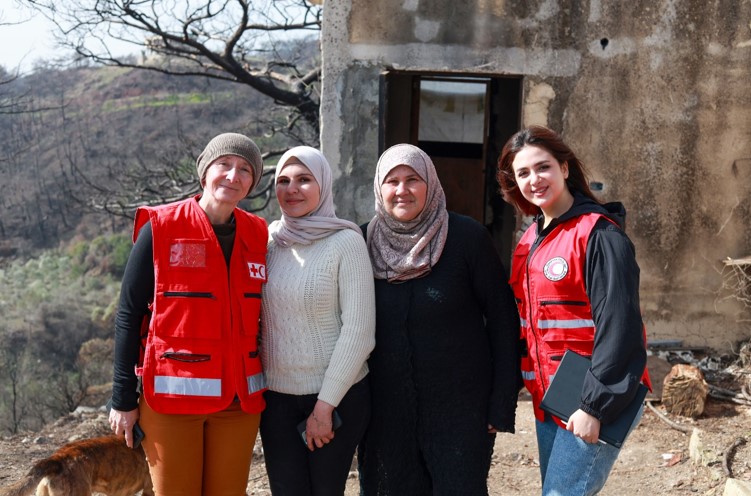
MARIANNE PECNIK, DISASTER MANAGEMENT EXPERT
Livelihoods – When aid creates opportunities
A particularly important part of my work is supporting the Syrain Arab Red Crescent's (SARC) Livelihoods Programme. Since 2015, over 1.9 million people have been reached through agricultural support, small business development or income-generating measures.
I am currently involved in several projects:
Support for small business owners in Homs (Tartous, Lattakia, As_Suwayda and Quneitra), Planning of entrepreneurship training courses, Distribution of cash grants, Climate resilience projects.
Projects in Syria rarely run in a linear fashion, so flexibility is a top priority. My role ranges from project planning and budgeting to monitoring systems and quality assurance for reports. The structure and responsibilities are documented in detail. I often sit down with my colleagues from the Livelihood Team to discuss baselines, PDM results or adjustments. We talk about markets, risks and training modules – but in the end, it always comes down to the same question:
How can we reach as many people as possible and ensure the quality of the projects - here are two examples:
Mushroom Harvesting
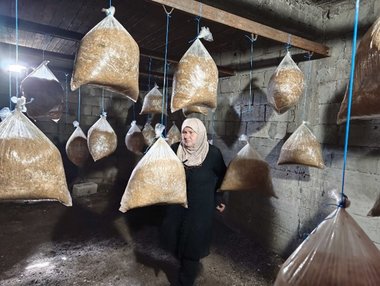
Ilham is a 55-year-old woman in Latakia who determined to create an independent and sustainable source of income. After researching small-scale agricultural opportunities online, she identified mushroom cultivation as a promising option.
Her interest grew even stronger when she learned that mushroom spawn was being produced locally by another beneficiary, Mehran. The availability of a local supplier made her business idea both practical and cost-effective.
Project Concept
Ilham’s project focuses on growing and harvesting fresh mushrooms. Her work complements Mehran’s business, forming a natural link within the local value chain. By sourcing spawn locally, she reduces transportation costs and ensures the freshness and quality of her inputs.
With the support of a $2,100 livelihood grant, Ilham established a controlled growing environment. The funds were used to:
- Purchase high-quality mushroom spawn and growth substrates.
- Install systems to regulate humidity and temperature, which are essential for healthy mushroom growth.
- Invest in sterilization equipment to maintain hygiene and prevent crop loss.
- Prepare and adapt the physical cultivation space to meet production standards.
Ilham expanded her business gradually:
- Phase 1 – Local Sales: She began by selling within her immediate neighborhood to test product quality and demand.
- Phase 2 – Citywide Distribution: As demand grew, she expanded her reach across Latakia.
- Phase 3 – Restaurant Contracts: She secured supply agreements with several local restaurants, ensuring consistent income and steady demand.
Ilham’s project demonstrates the power of interconnected livelihoods. Together, her cultivation business and Mehran’s spawn production strengthen the local agricultural value chain.
- They collaborate on cross-promotion and marketing.
- Their “seed-to-table” approach keeps added value within the community.
- The model reduces dependence on external suppliers and strengthens local economic resilience.
Wheat Cultivation
Osman Jaqal, 56, returned to Syria after spending 13 years in Turkey’s Osmaniya camp. Although difficult conditions initially discouraged him from returning, his determination to restore his ancestral farmland eventually brought him home. Today, he is rebuilding his life through wheat cultivation.
To help him restart, Osman received a $2,100 livelihood grant. He invested the funds in essential agricultural machinery and land rehabilitation, directly improving his farm’s productivity.
Results and Sustainability
- Reliable Water Access: His land is located near a river, providing a dependable water source for irrigation.
- Climate Resilience: Despite recent localized flooding, his crop survived with minimal damage due to careful timing of the planting cycle.
- Family-Based Enterprise: Osman works alongside his wife and three children. The farm now provides the family’s main source of income and significantly reduces household expenses.
Osman’s story illustrates how targeted agricultural support enables displaced families to return home with dignity. By restoring their livelihoods, they regain self-reliance, support their families, and contribute to the stabilization of the local economy.
Syria today
In 2026, Syria is no longer making headlines – but the crisis is not over: Floods are destroying homes, drought threatens livestock, forest fires destroy livelihoods.
And yet there are success stories that give cause for hope.